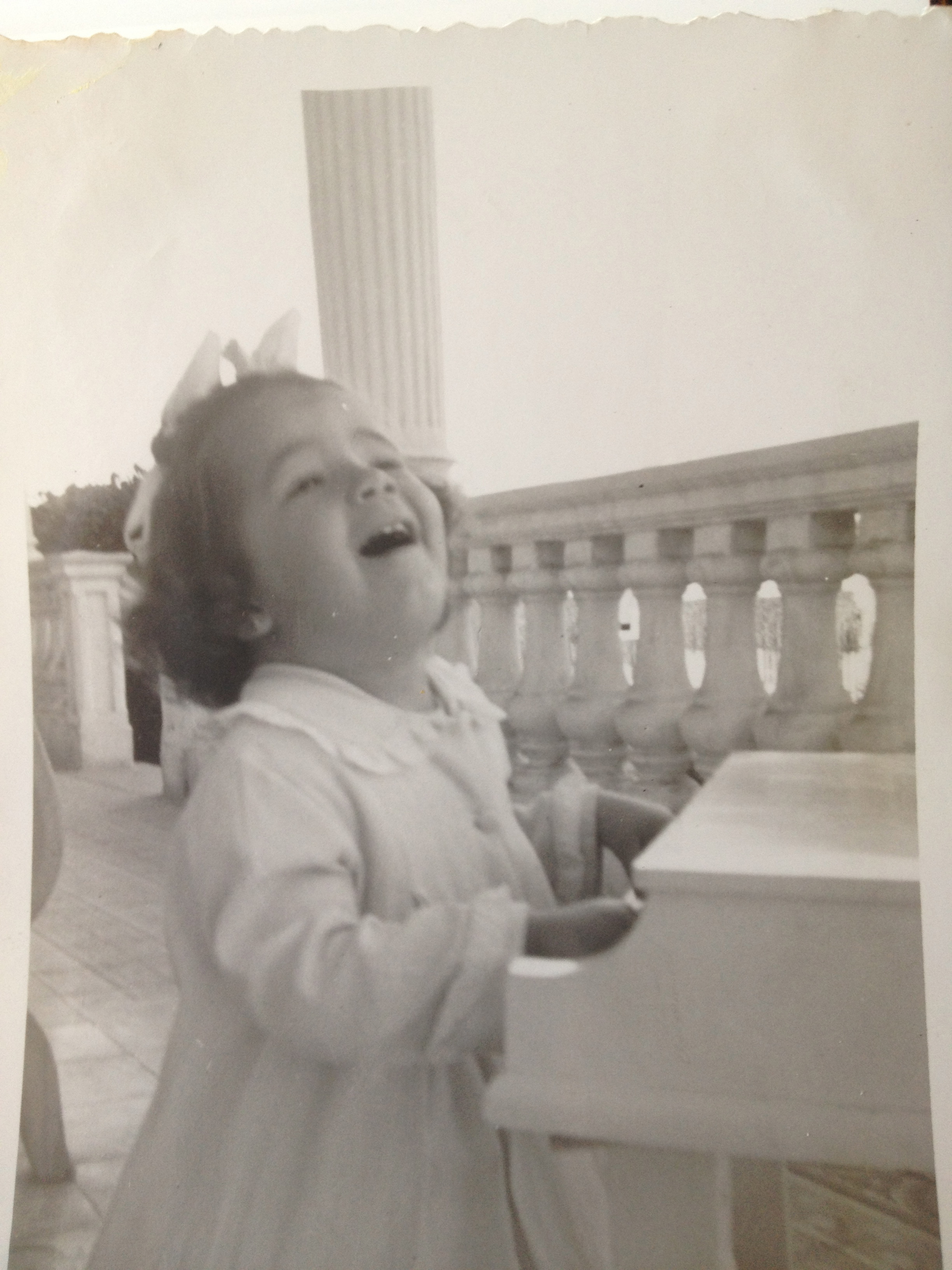
Playing my toy piano in Havana, Cuba
Experiencing Exile And Freedom Member PEN INTERNATIONAL
Playing my toy piano in Havana, Cuba
In my experience, life-changing days do not announce themselves. This was the case a few months ago when an ordinary day came to an end and I finished my nightly ablutions and approached our bed.
I said to my husband: “Did you take the dog out?” but heard instead a muted flow of unrelated syllables. Suddenly there was an unexpected stillness inside broken by the sound of an interior voice: “You are having a stroke”. Seconds passed that seemed an eternity. I remained eerily calm. I was in my body. My body was in danger. I could not communicate. I needed an aspirin. I needed to go to the hospital. I felt no fear. I was acutely aware of the separation between “me” and my body, but not “out of body”.
Two weeks earlier I had decided to move my private practice to a more suitable location. I found a space I fell in love with. I came to a verbal agreement with my new landlord, called the movers and arranged a date and time for my move. But when the day of my move came, “something” made me stop the process. The message was loud and clear, and unlike other times in my life when I had ignored such messages with not very good results, I decided to listen. On the very day of the move I told the movers to move all the furniture to our garage. I was absolutely certain despite all reason that I was not to move to my new office.
My husband of twenty- five years did not try to dissuade me. He watched, he listened, and he supported my decision. We both thought perhaps the warning had to do with the space itself, had faith that I would know when the right time came.
Now the warning became clear. A stroke.
I stood still, still acutely aware but with no sense of panic for seconds before I began to attempt to communicate to my husband what had happened. His back was to me and he is hard of hearing. I mustered all my energy and tried to enunciate my words: “I AM HAVING A STROKE!” I heard “ah ah ah ah”. Tears began to flow unbidden. My husband turned to face me. He saw my confusion written on my face and realized something was seriously wrong. When I tried to speak again, he got it. He immediately reached for the aspirin, gave it to me, and got dressed. The hospital was less than a mile away. We were there almost immediately. In less than two hours my speech had returned. I could be understood, although speaking took an unprecedented effort. Hours later I left the hospital. Days later I underwent surgery to clear the blocked artery in my neck that led to the stroke.
After the surgery, the calm that accompanied the incident was gone. I became impatient with myself, wanting the ease of communication I had before. I dreaded sitting at my computer. Would I still be able to write? I wondered what a writer did when the mind could not focus, could not find the words necessary to express itself. From the inside of me to the outside world there seemed to be an insurmountable distance.
I remembered a Hospice patient I once had who suffered from Lou Gherig’s disease. She had been lucid but trapped in a body that could not communicate. At the time I was astonished at her will to live, wondering what made her cling to life so hard despite her circumstances. Now I saw her situation from a different vantage point. Life was precious, even when lived from a distance. She had been at peace.
But not I; I was outwardly inpatient, impossibly emotional, unable to concentrate. I had a sudden insight that I was no longer familiar with myself. Normally patient and slow to anger I became impatient and able to reach rage stage quickly. My normally quiet spirit was in turmoil. It had once felt like a peaceful dove. Now it reminded me of a hummingbird in perpetual motion. Such effort to be a hummingbird! I wondered if that was why hummingbirds often seemed ill humored. I could identify.
Shortly after the surgery I was told that the arteries to my heart were blocked. I saw the best specialists who all agreed that I was “a ticking time bomb”. My husband and my children were extremely concerned. My children advocated surgery. My husband offered his support in whatever I chose to do. Despite conceding that the open-heart surgery might be the best way to proceed from a medical standpoint, my spirit once again sent out a warning that I could not ignore. NO SURGERY. STOP. NOT NOW. My body was not strong enough to survive another invasive procedure. I knew that. Not yet. Immediately a name from my past surfaced: Dr. Dana Myatt. I set out to find her.
Dr. Dana Myatt was someone I never forgot. I met her almost twenty years ago when she had just finished school. I recognized in her the spirit of a true healer. Dr. Myatt was a dynamo whose focus was how to make her patients better. She poured her seemingly endless energy into being the best physician she could be. I looked for her and found her and she agreed to work with me despite her very busy caseload. She and her husband, Nurse Mark, made a commitment to help me heal. I could do no less for myself.
Dr. Dana did not try to dissuade me from undergoing surgery. She told me what she could do for me, and what she thought we could improve, and offered her support in whatever decision I made. She gave me a diet to follow, a list of supplements to take, and bless her heart, she even took on my hummingbird spirit. She has been there for me every step of the way, watching me succeed, rejoicing in every victory, and digging deep for knowledge to meet the challenges of my sometimes unique symptoms. She is the physician we all yearn for and deserve but seldom find. My gratitude to her for walking this journey with me is endless.
Slowly I am finding my way back to my writing, my way to myself. I have learned much about friendship, and even more about love. My husband has walked with me every step or the way through a very difficult few months when the woman he fell in love with almost disappeared. My children put away their fears to respect my wishes. I know how difficult that has been for them and it makes me proud to know that supporting me has been more important to them than convincing me to act against my wishes to assuage their fears.
The last few months have been full of challenges and blessings. Meditation has become possible and I have discovered peace exixts in the space between the movements of the wings of the hummingbird. Life is the more precious for its fragility. Love the more magnificent for its constancy.
An article by Carlos Eire:
My Struggle Against Lies About Cuba in the U.S. Media
Imagine this.
Thugs take over your country. Much more quickly than you ever thought possible, one megalomaniac takes control, discards the constitution, abolishes free speech, takes over all of the news media, bans all sorts of books and films, closes down all private schools, expels most of the clergy, and abolishes all private enterprise and personal property. In the wink of an eye, he also seizes all the banks, wipes out all accounts and changes the currency so no one can have more than a week’s pay in their pocket.
In the meantime, as these changes are taking place, all who oppose the new regime are imprisoned, tortured, or executed. Some simply disappear. Spy houses are set up on each city block, to watch your every move, and these very same government agents are placed in charge of herding you to public demonstrations and telling you what to shout out. In addition to assigning you all sorts of “volunteer” tasks that amount to slave labor, these meddlers are also given control of your access to medical care, of your children’s placement in school, and of the ration cards that you need in order to survive.
Eventually, anyone suspected of being gay or too religious is rounded up and sent to concentration camps, where “experts” try to “cure” them of their “illness” through torture.
Should you murmur the slightest complaint or curb your enthusiasm, you will not only risk prison, but also imperil your family’s well-being.
Should you opt for exile, your neighbors suddenly “volunteer” to harass you constantly. You may also be forced to spend three or more years at a labor camp, working without pay, hundreds of miles from your home and family, before you are allowed to emigrate. When you finally do manage to leave, all of your remaining possessions are taken from you, including your family photos, your wedding ring, and the rosary or mezuzah your grandmother once gave you. After being strip-searched, you leave the country without a penny to your name, and only two changes of clothing in a very small bag. Suitcases are forbidden.
Or you may risk your life and flee in a flimsy raft under cover of darkness, knowing that there are many sentries patrolling the coast, with shoot-to-kill orders, and many sharks waiting to chew you up if your vessel sinks.
Then, imagine that once you get out, nearly everyone in your place of exile tells you that the totalitarian nightmare you have fled is a wonderful and praiseworthy experiment in social engineering, or even an egalitarian utopia. Imagine being scolded for disagreeing with such assessments. Imagine being told by many affluent and well-educated people that you are a selfish oaf who doesn’t give a damn about justice and can’t appreciate “visionary” leaders.
Welcome to Cuba, and also to the life of a Cuban exile.
Want to get a little deeper under this skin? Imagine this, if you can. The megalomaniac and so-called visionary leader who has hijacked your country for five decades falls ill and appears to be near death. One of the finest newspapers in your adopted land goes out of its way to ask for your opinion, presumably because you have managed to become a well-respected scholar. But this journal, The New York Times, doesn’t really want you to speak your mind. No. Instead it wants you to pass judgment on your fellow exiles who are openly rejoicing in Miami. And they suggest the topic in the most offensive way you could ever imagine, with a remark as flippantly ignorant and insensitive as Marie Antoinette’s infamous “let them eat cake.”
“I can’t help but wonder if this rejoicing is appropriate,” says the Times editor about the street revelers in Little Havana, “since many of them were likely allowed to leave Cuba in the early 60’s with Castro’s blessing.” Then, as if this were not vexing enough, she asks you to lay all your cards on the table and state your position on this question explicitly, to see whether or not your opinion is worth considering. And when you comply and offer to sum up the ailing tyrant as the consummate Machiavellian prince, you are curtly dismissed…
“We’re afraid that this approach is not quite right,” said the editor. Imagine that.
God knows what they were searching for at the New York Times, or what they expected of me. All I know is that the Times made me feel as if I were back in Cuba, dealing with its state-run propaganda rag, Granma. Or like a “negro” in the old South, dealing with segregationists who couldn’t understand why colored folk were so ungrateful about being rescued from Africa.
But that’s not all.
If it were only the New York Times, maybe all of us Cubans would be in better shape, in exile as well as on the island. But, unfortunately, it’s not just the Times that loves to idolize the Castroite Revolution. It’s most of the North American and West European media, and their glitterati. Or so it seems, most of the time.
When Fidel Castro visited New York in 1995 to give a speech at the United Nations, he was the toast of the town’s news oligarchs: Mort Zuckerman, then editor of U.S. News and World Report, hosted a lunch for the tyrant at his plush Manhattan apartment, where he and others such as Barbara Walters, queen of tear-jerking interviews, and Diane Sawyer, first prime-time anchorwoman of ABC News swooned in his presence, as if he were a rock star.
(1) Barbara and Diane are in good company. Dan Rather, former anchorman of CBS news, called Fidel Castro “Cuba’s own Elvis.”
(2) Imagine Hitler or Mussolini being compared to Elvis. Imagine all of this happening to Idi Amin, Sadam Hussein, or Augusto Pinochet.
Imagine even worse.
If it were only the news media, then maybe we Cubans would stand a chance of redemption. But the American entertainment industry seems to love the tyrant and his henchmen too. Robert Redford glorifies Fidel’s sidekick Che Guevara on film in “The Motorcycle Diaries,” and since that is apparently insufficient, Steven Soderbergh follows suit with a six-hour epic hagiography that might as well have been entitled “Saint Che.” Director Oliver Stone praises Fidel as “one of the world’s wisest men.”
(3) Actor Jack Nicholson calls him “a genius.”
(4) Supermodels Kate Moss and Naomi Campbell gush after meeting Fidel that this was “a dream come true.”
(5) Not to be outdone, novelist Norman Mailer pronounces Fidel “the first and greatest hero to appear in the world since the Second World War.”
(6) But in the end, no one could trump the French, those supreme arbiters of good taste. After all, long before Hollywood stars made pilgrimages to Havana existential philosopher Jean-Paul Sartre had already crowned Che, rather than Fidel, as “the most complete human being of the twentieth century.”
(7) No wonder we Cuban exiles are seen as the fiends and villains of our own story, and of American politics. No wonder we’re loathed by intellectuals and commoners alike. No wonder the Washington Post and scores of American newspapers can get away with publishing this cartoon with impunity.
Imagine any other immigrants or any ethnic group in that boat. Imagine the firestorm of protest that would ensue.
Imagine the charges of bigotry and racism leveled against the cartoonist and the newspapers who would print such an offensive cartoon.
One final meditation. Imagine this, if you can.
Imagine a New York Times or Washington Post that would dare to print this essay, or apologize for their abysmal ignorance and bigotry
_________________________________________________
Notes
(1) Servando González, The secret Fidel Castro: deconstructing the symbol (InteliNet/InteliBooks, 2001), p. 35.
(2) “The Last Revolutionary”: interview of Fidel Castro by Dan Rather, CBS News, 18 July 1996.
(3) Myles Kantor, “Oliver Stone’s Cuban Lovefest,” www.frontpagemag.com, 5 May 2004.
(4) Army Archerd, “Nicholson, Castrow powwow in Cuba,” Variety, 15 July 1998. http://www.variety.com/article/VR1117478496?refCatId=2
(5) BBC News. News. http://news.bbc.co.uk/2/hi/americas/59225.stm
(6) Arnold Beichman, “Mona Charen Exposes Menace of Senseless Liberals,” Human Events, 17 February 2003.
(7) Frank Rosengarten, Urbane revolutionary: C.L.R. James and the struggle for a new society (University Press of Mississippi, 2008), p. 108.
_________________________________________________
*Carlos M. N. Eire is Professor of History and Religious Studies at Yale University and author of Waiting for Snow in Havana and Learning to Die in Miami. This article is based on a lecture he delivered at the Institute for Cuban & Cuban-American Studies, University of Miami, on November 21, 2011.
_________________________________________________
The CTP can be contacted at P.O. Box 248174, Coral Gables, Florida 33124-3010, Tel: 305-284-CUBA (2822), Fax: 305-284-4875, and by email at ctp.iccas@miami.edu. The CTP Website is accessible at http://ctp.iccas.miami.edu.
As we sang God Bless America I became aware of forms beneath the water. It was land beneath the water; my new land. My eyes began to scan the horizon looking for Miami. No signs of land above the water yet.
I looked at the top of the head of the little boy beside me. His sobs had subsided and now he stared straight ahead at the back of the seat in front of us. He had told me his name was Ignacio and I remembered my American friend Marilyn who called her neighbor Ignacio “Ineichio”. I wondered if this child would ever hear his name pronounced correctly again; I wondered if he would ever hear his mother calling his name softly to wake him in the morning for another day of school; if his last memory of his mother would be the woman with the jerking shoulders – human turned marionette by the force of her grief. He had screamed for her helplessly as a militiaman pulled him away from the glass of the pecera (the fish bowl) and led him towards the door in the opposite direction smiling like Tom the cat when he had Jerry the mouse just where he wanted him. This little gusano was going to pay.
The cabin became quiet. To our left ocean turned to city in one moment, catching us all off guard. Flat land. Strange land. Oh my God! No turning back! No turning back! Somebody help me!
I know what it feels like to lose my mind, for I lost it descending the airplane steps; metal steps leading to concrete.
I was to look for a man named George. A stranger. Fourteen years of protection from strangers and now my life was in a stranger’s hands. Look for George. Look for George. How do I find George?
A place full of children; girls in a cafeteria; a chain link fence; boys on the other side of the fence. Some girls and boys holding hands through the fence. Brothers and sisters who had just lost their parents being separated by a fence! God help me please! So much pain! God where are you? I want to go back.
I don’t know how long I was out of my mind, out of my body, but somehow someone made sure I got to my final destination, Clarita and Ruben’s apartment in Miami’s Little Havana. My new foster home. Why did they call it that? It looked NOTHING like my Havana!
Half a century has passed and Cuba is again becoming a tourist destination though nothing has changed. The Cuban people are subjugated by a merciless regime that once purported to be Communist and today seems to be flirting with its own version of Capitalism- Capitalism without a shred of democracy.
I say to myself, enough already! Quit looking backward! There is nothing to be gained. For the most part I manage. I stay in the present. But sometimes…the scab comes off and oozes the accumulated pus of decades and I find that like Sara in the bible, a part of me is frozen, like a pillar of salt. It is a child standing still in the desert, craned neck looking behind her with a longing that only a child having been stripped of everything can know.
One of the risks of living on this earth so long is that eventually you are bound to upset people, including sometimes those who love you and who you love most.
My last blog, To Hate or Not To Hate, appears to have upset many who have privately emailed their disappointment with my “political views”, their disappointment that their friend is so different from them.
For many Pedro Pans like myself, and for many Cuban exiles in general, the words liberal and Communist are too close for comfort. Add to that the fact that I am involved in writing a book with Martin Guevara, Ché Guevara’s nephew, and I become a suspect in their midst. Someone to “be careful of”; someone to disassociate from as soon as possible. I could be “the enemy” in disguise. Some have called me a “traitor”.
I am not a “typical” Pedro Pan. Very quickly after my arrival I left the camp where so many stayed, to live with a foster family. A few months later my family, who had stayed in Cuba in support of my imprisoned father, arranged for me to go to boarding school in California. There, I had no Cuban friends, no Cuban culture, no Cuban influence whatsoever. I became truly bicultural, and embraced my new country and my new language. I lived in Miami a total of a few months through the years and visited once a year for a while, but I never made “new” Cuban friends. I never lived in a place with a Cuban community for long. The melting pot truly melted me. I married an American, had children with him, divorced and remarried another American.
That is not to say I stopped loving Cuba; that is not to say I forgot my past. To this moment in time I love Cuba fiercely, passionately if you will. My memories of every moment of my childhood there are etched in my soul forever. But having been planted in a different garden than the majority of other Cubans, I became a different flower.
It is not the purpose of my blog to criticize my friends or their beliefs. I know both them and their beliefs intimately well. Despite our differences, we share many things in common, not the least of which is knowing how it feels to lose everything and everyone you love in the space of a day, to have your soul ripped apart by one man’s megalomanic journey, to have been betrayed to the depths of one’s soul, and to watch from far away as the land you once called your own is pillaged by hatred and incomprehensible violence by one’s own people. I understand their position because I once held it, and I defend their right to hold it.
Whoever I am, whatever I have become, I own. I have no desire to convert others to my way of thinking, for my way of thinking is never static enough to wait for that conversion nor is my certainty of rightness such that I want followers on my path. I have broken every commandment, I think, except Thou Shalt Not Kill, although there are many ways of killing people besides really killing them and I am not sure that my words have not mortally wounded. I hope not.
I have known poverty, struggle, illness, doubt, loneliness, and I have known joy, exuberance, satisfaction, and I have known love. All these things have taught me lessons meant for me, and all those things have led me to value freedom above fear, love above hate, tolerance above intolerance, humility above pride. I believe with all my heart that we are nothing without one another regardless of our color, sexual orientation, or creed. I believe that we all have the right to a world where Cuba cannot happen again. I suspect that such a world will require that we at least contemplate awakening to new ways of communicating with one another, of supporting one another, of remembering the lessons of the Masters who have spoken the language of eternal love. But of course, I could be wrong.
I was a child when I became aware of man’s capacity for violence and cruelty. Surrounded by my schoolmates, all of us gamely facing the challenge of learning to write with a real ink pen, playing jumprope in the schoolyard, forming lifetime friendships, and beginning to catch a glimpse of a world outside our respective homes, we were perhaps a little unprepared when the nuns introduced us to a man named Jesus. Jesus loved us, even though he hadn’t met us. He loved everyone. He was a good man. He was the son of God. The son of the man that the Baltimore Catechism taught us “knew all things”.
It was inconceivable to my six year old mind that the good man Jesus, who had never hurt anyone, had been cruelly put to death on a cross. That he was nailed to that cross. That he hurt for hours and no one rescued him, not even the angels in the heaven where his Father ruled. Not even his Father!
Nightmares followed, as they often did in those early days of learning about the all knowing God and his son Jesus, while I was filled with love, puzzlement, and fear about all the mysteries surrounding me. The spiritual world became almost as real as my waking world, and perhaps it was then, kneeling before my Jesus crucified for no good reason, that I began to rebel against injustice. Kneeling in front of the cross all of the lessons about forgiveness, turning the other cheek, loving thy neighbor as thyself, all the lessons of goodness took root on the fertile ground of my innocence. Somewhere in my being, I also stored the incomprehensible shadows of evil and man’s inhumanity to man.
It was not long after those experiences that I arrived home one day to a horrible stench, arrived home to find a man who had been dipped in tar lying on my bed. He was dying. My father, who had somehow negotiated his release from a Batista prison, had brought him to our house to die “in peace”. His fingernails and toenails had been ripped from his body. His excrement and urine were unable to escape and he swelled like no balloon I had ever seen. My spirit was even more unprepared for the suffering of this man, my tutor Marta’s brother, than it had been for the cross of Jesus. As I took in the stench, the blood, the agony of the man on my bed, words roared in my mind:
“Father, forgive them, for they know not what they do”
“Love your enemies and pray for those who persecute you, that you may be children of your Father in Heaven.”
I began to say the Our Father for the man lying in my bed, as I tried to hold my breath and take in the inconceivable tableaux.
Years later, long after the man had died on my bed, the mattress had been replaced, and the room repainted, a bearded man named Fidel arrived in Havana with contagious visions of freedom, with promises of love and respect for his fellow man. He proclaimed himself our savior, and in a country where The Savior was worshiped, it was easy for him to find fertile ground for his gospel among the people of the island. At first we didn’t want to see the incongruence of the men who wore crucifixes and carried guns. But it wasn’t long at all before the executions began and the blood began to flow again. I watched the mock trials on TV while thinking: “Father, forgive them, for they know not what they do.” And it wasn’t long after when one of the saviors hit me in the face with the butt of his rifle as I clung to his beard desperately trying to stop him from taking my father to a prison cell where he would pay for wielding his pen as a weapon against the regime. Still as they left the house the words roared despite my fierce anger and fear : “Love your enemies and pray for those who persecute you that you may be sons of your father in heaven”.
Fifty years ago I arrived in this country as part of the Pedro Pan exodus, an exodus of over fourteen thousand children whose parents gifted with the possibility of living in freedom. We came to a land of opportunity, a land where we were told we could be and become anything we wanted.
I landed in the sixties at a time when being white meant I could not sit in the back of a bus with my black brothers and sisters, or drink from the same water fountain they drank from outside my doctor’s office in San Antonio, Florida. At the time, not even the black people seemed to mind that state of affairs. But for the rest of its citizens, this country, now my country, seemed to indeed offer endless opportunities to succeed. Time passed as did the voices of my childhood exhorting me to forgiveness. My fear of Cuba happening again led me to become a Goldwater Girl, enticed by my ideals as well as by the scent of English Leather Barry Goldwater’s son liked to wear. For a while I became an “against” machine. Against Communism, against the people Archie Bunker would one day refer to as “pinkos”, against anything that would allow for the possibility of any child’s father ever being ripped away from their arms to be taken to a prison for thinking or speaking his mind. The shadows in my being that had found no room in the child I was then, began to sprout roots in the form of prejudices and hatreds as the young woman alone lost herself having been given the opportunity to become anything she wanted before she knew what that was.
If there was a particular incident that helped rescue me from my againstness, I have no memory of it. Slowly or abruptly I came to realize that the shirt of conservatism was a straight jacket that would forever force me into a position from which I could not escape. A place of no growth. It was a place that asked me to become blind to the fact that NOT all men are equal in talent, in life circumstances, in health, or in creed. That asked me to believe that EVERY person could “pull themselves up by the bootstraps” out of poverty, out of addiction, out of any life circumstance. It was a place that kept me from imagining a world of possibility, a world where perhaps one day man would love man enough to help man when man needed help. A world where a government OF THE PEOPLE, FOR THE PEOPLE would help the people to live a decent life, a healthy life; a world where people of all colors could rejoice together; a world without war, without violence; a world without hatred.
It is a world that seems to be slipping further and further away as the elected officials of our country appear to be more intent on destroying our country’s first black presidency, than on the urgent needs of the people they were elected to serve. Hateful emails clog the internet taking us back to the days of segregated buses and the “n” word, while a condition resembling amnesia affects those who try to make our president appear to be responsible for our current circumstances. We walk away from blaming not only the last few administrations led by white presidents for the disaster we are living, but we walk away from facing our irresponsible handling of our financial lives.
I fear that we are nearing the end of an era. That the myopia of hatred will forever eradicate the far vision of freedom. That those leaders purporting to be fundamentalist Christians will not take into their hearts the words of the fundamental Christ that they hear every week in their churches when they contemplate the issues facing the poor, the ill, the aged, the different. Words like:
“For I was hungry and you gave me food, I was thirsty and you gave me drink, I was a stranger and you welcomed me, I was naked and you clothed me, I was sick and you visited me, I was in prison and you came to me.
Then the righteous will answer him, saying, ‘Lord, when did we see you hungry and feed you, or thirsty and give you drink? And when did we see you a stranger and welcome you, or naked and clothe you? And when did we see you sick or in prison and visit you?’
And the King will answer them, ‘Truly, I say to you, as you did it to one of the least of these my brothers, you did it to me.’”
(Matthew 25.35-40 )
Haydecita came into my life when I was in second grade. A mischievous grin, beautiful brown eyes and a heart of gold, we became fast friends quickly. She was one of four children, I an only. I loved going to her house where we would play duets on her piano, swing on the indoor swing set, and sometimes swim in the pool. And we would eat raw oysters every chance we got. She in turn, enjoyed coming to my house, an old and beautiful house where we played every game imaginable, sometimes joined by my beloved next door neighbor Piti.
When we were in third grade Haydecita and I learned to say the Catholic Mass in Latin. Both of us enamored of our Jesus, devout little girls who wanted to become priests….
My family accommodated our devotion. They would sit through the Holy Mass with rapt expressions, as if the house had become a church and their chairs faced the altar. “Dominus Boviscum” we would say, and they would answer “Et cum spiritu tuo”. For many members of my family it was the only time they attended church. Although we were NOT priests, I like to think that our devotion took their souls to a good place.
By far our favorite thing about her visits to my house were the times we spent with my grandmother, my Abuela. From the time they met, Abuela loved Haydecita. And Haydecita loved Abuela. I was never jealous of that love for when the three of us were together it seemed Abuela and I were closer. Abuela loved to sew, knit and embroider. In my friend she found a kindred soul for unlike me, her flesh and blood who much preferred her bikes and skates and books, Haydecita wanted nothing more than to learn everything that Abuela wanted to teach her. And teach her she did. At almost every visit for the next few years we would spend time with Abuela sewing, knitting, embroidering. I would get bored long before she did but I treasured the oneness of our threesome and so stayed. We shared so much over those years, trips to historical places in our Cuba, trips to her farm, to the beach, but the times with Abuela were really special.
Not long after the arrival of Fidel, Haydecita disappeared from my life without warning. We lost each other. When I arrived in Miami Haydecita was in boarding school back East and soon I was in boarding school in California. Back in the days before email and when long distance calls were not affordable we had no chance to keep in touch.
Over a year ago by magic we found one another again. By Grace she was to be in Seattle for a workshop. She asked me to join her there. After fifty years we reunited for a weekend together. I took the train, a three hour ride , then a half hour cab ride to the hotel where we were to share a room. Almost strangers now yet drawn to each other by the memories of Latin Masses, school, our Cuba….and Abuela. I hoped I would recognize her for we had not shared grown up pictures in our emails. What would she be like? I lingered in the cab talking to the driver, a young exile from Nigeria who wants to become a writer. Haydecita was waiting just yards away, out of my sight. Fifty years. I could hear my heart beat in my ears. Every step was a step into my past, every step a step into the future. Would there be a future for our friendship? Were we crazy to come together in such close quarters for a weekend after half a century?
Stepping through the door of the hotel I looked around and saw her looking at me. Our faces weren’t that different from the children we had been. Our embrace was genuine. Our eyes met and the years fell away. We dined at a Cuban restaurant in Seattle, steeped in conversation, enjoying the food of our childhood in communion. From the first few minutes there was this quiet and sacred connection, as we found that different and sometimes arduous roads had brought us to similar spaces. Sacred spaces that we cherish.
Again, Grace brought her back to the West Coast, this time for a workshop in Portland, 23 miles away! And do you know what she brought with her? Supplies to teach my then eight year old twin granddaughters how to embroider. A “J” for Jamie and and “E” for Erin. The girls struggled to learn this new art as their own grandmother had, but my friend patiently taught them what to do. I watched as I felt Abuela’s spirit surrounding us in the room, not doubting for a moment she was there watching as her favorite pupil gifted her great granddaughters with the craft she had loved. My heart filled with memories of Cuba, of Abuela, of Haydecita and I with our needles and threads…my friend was here. She was here with me, as was Abuela, and we were surrounded by love while making new memories.
This has been a difficult year for me.. Haydecita and I keep in touch through email and occasional phone calls. Our souls are never far away. Tonight, as I was getting ready for some quiet time and tough decision making, my husband brought a little package from the mailbox; a little package from New York. In it was a pair of socks. Not just any socks. Socks Haydecita made for me that look and feel like love. Every perfect stitch speaks of quiet times with Abuela, of shared memories past and present, of precious friendship, of her love for God and for excellence in all she does. She sends me warmth for my feet because she sees my heart already warm. My heart is so much warmer now as I sit here with my new red socks on. My beautiful and perfect red socks full of Dominus Boviscums, and Et Cum Spiritu Tuos, memories of a mischievous grin and a myriad of adventures, of a land that saw us grow, and a woman who loved us both.
Note: Haydecita’s son Mark VonSternberg, produced and directed his first film called Love Simple. It is very good. Find it. Watch it. It will touch your heart.
January 1, 1959 marked not just the culmination of a long effort of struggle by our people over the course of many years, over nearly 100 years at that time. That day was not just the day of victory; it was also a day of great decisions, fundamental decisions, and a day of great definitions, great lessons, and great training. Because on January 1 victory was not only won, it also had to be defended…Our people wanted change, our people wanted a revolution, and the changes had to be deep-going and fundamental, the exploiting society had to disappear. And we told the people that this time the revolution had triumphed, that the demands of the revolution would be fulfilled! Fidel Castro
“Fidel arrives as a messiah. Young, bearded, and at the head of a guerilla army. That unleashes the imagination and the fantasy of the Cuban people.” Carlos Alberto Montaner, Author
This is a man of huge appetites and huge ambition. Georgie Anne Geyer, Journalist
One night we were studying and we decided to take a break and we went to have a café con leche. And we started talking about the future. And I said I’d like to travel and have a lot of friends, which was the truth. And another guy said, I want to be a poet. Another wanted to be a lawyer. Then I turned to Fidel and said, “Guajiro, what do you want?’ And he said, “I want glory and fame”.
Alfredo Esquivel, Schoolmate
Fidel, Camilo and Che were my heroes. They had saved my country from Batista. There would never be a man dipped in tar dying on my bed again.
I was eleven the day the militia arrived in Havana. The depictions of this day in movie reels and documentaries show people in the streets rejoicing and sometimes fighting. Fidel arrived smiling triumphantly and waving to his new subjects from a tank turret with his friend and fellow combatant Camilo Cienfuegos. Camilo looked like Jesus. Che Guevara shone by his absence. Fidel, not wanting the popular Argentinean to outshine him, left him at the La Cabaña Fort accepting the surrender of three thousand men said to have been members of Batista’s troops. It seemed all of Havana was at the plaza to see and welcome their saviors. Now, looking at me from old movie reels, the faces of my countrymen seem filled with joy and hope and triumph. Not a trace of the defeated, angry, or cowed Cuban people on the island today.
When the Milicianos, the Militia, marched into our neighborhood in triumph a couple of days later, Fidel wasn’t with them. They appeared suddenly and unexpectedly, marching in silence. At the sound of their rhythmic footsteps, little by little, the streets began to fill with spectators. I ran outside my house to the sidewalk with my tata, (my nanny) keeping watch. My grandmother and the rest of the adults watched the procession from the porch.
I saw beautiful young men of all colors dressed in militia uniforms, with long hair and beards, walking six to ten abreast through our street. Many of them wore rosaries around their necks, inches from the straps that held their rifles. When I close my eyes I can still see all their crucifixes glinting in the afternoon light …and hear their footsteps.
They walked in silence. We watched in silence. The silence has stayed with me as a peculiarity because it was remarkable- some would have said impossible, for Cubans to be silent in celebration. The silence seemed appropriate for the solemnity of the occasion, as these men carried the hopes and dreams of a country on their young shoulders. Young shoulders bearing their crucifixes and their guns.
One of the men approached me and handed me a bullet from his belt. He must have seen the adoration in my face. Standing in front of our house, a rather palatial structure, I became aware of an occasional glance of hostility from a handful of my heroes. I didn’t understand its source and though I was uncomfortable, I don’t remember asking the adults what the glance meant. I enjoyed the moment of victory and reveled in the thought that the pain was over. Now our country would be free and my father would be safe. We would all be safe. The time of whispers was over. Now we could freely speak about our world.
My family was happy save for what I sensed at the time to be some caution, some “let’s wait and see” attitude on my grandfather’s part. I rejoiced in the knowledge that my friends and I would be able to go to the movies without checking under our seats for bombs.
Our Christmas break from school had been extended, and Piti, Olguita, Rosita and I, went about collecting bullets from any Miliciano that walked past our houses. No more sticker books of the Wonders of the World. Bullets of every size became our most prized possessions and our new status symbols. My Tata Margarita kept my collection in her room, fearing the bullets could explode if I wasn’t careful. All my tatas, at one point or another, seemed to catch the fear of the household as if it were the common cold.
My dad, instead of being ecstatic and celebrating Batista’s leaving, appeared to be pensive. My grandmother, on the other hand, had already decided there was trouble. During a speech, shortly after Fidel came to power, doves, symbols of peace and the Holy Spirit, were released. One of them defecated on his shoulder. My grandmother was sure it was a bad omen.
My aunts had resumed their rounds at the Havana Yacht Club, and the Havana Biltmore. No politics for them! Theirs was a life of the latest in couture, the best hairdresser, the next game of Canasta and the search for the best available man. Their definition of that man and my grandparents’ definition were quite different, as it turned out. My aunt Celia continued to date an American Jew, Laskar J. Steinberg. Perhaps the largest courtship in history, as my beloved Uncle Larry waited twenty three years for the family to accept him. I had loved him right away.
When I went back to school, some of my friends were gone. Their families, who had been part of the Batista regime, had left for the United States and other countries. There were several empty desks in our classroom, never talked about by our teachers, as if mentioning them might initiate a discussion no one wanted to participate in. It was the first of many times that my friends would disappear. Eventually it became a way of life. We didn’t know that then. We were bereft not only from their loss, but because we realized we had spent years loving the enemy and had not known. We ripped these girls out of our hearts and banished them from our conversations. We were Fidelistas. We were the new generation of the Revolution. We experienced our first excursion into heartlessness. For some of us who couldn’t quite manage to extirpate our feelings so quickly, it was the day of our debut as actors. We would learn to always remain in character to survive.
We had been back in school a short time when again we were off for a few more days in February. Fidel had decided to hold public trials in the Palacio Deportivo, The Havana Sports Palace. Between fifteen thousand and eighteen thousand people witnessed these trials. CheGuevara was in charge. Some say Fidel put him in charge so that an Argentinean would be blamed for what happened in the plaza. So that all the blood stuck to him.
To send men to the firing squad, judicial proof is unnecessary…These procedures are an archaic bourgeois detail. This is a revolution! And a revolutionary must become a cold killing machine motivated by pure hate. We must create the pedagogy of The Wall! (El Paredon) Ernesto “Che” Guevara
Piti, Olguita, Rosita and I were riding our bikes in the yard at my grandparents’ house. Olguita fell down and scraped her elbow, so all of us went in the house to get a Band-Aid. As we passed the family room I was stunned to noticed my grandfather’s beloved bald head among the heads of all the adults who seemed glued to their chairs in front of the television. My grandfather at home on a workday… shades of the nights of whispers. Keep walking. Don’t stop.
Walking towards the bathroom closet in search of her bandaid Olguita said:
“How come your whole family is in front of the television?”
“I don’t know, I answered with my best casual voice: “probably Fidel is talking again.” But my old familiar uneasiness had awakened.
We were on our way out the back door when Rosa, one of our maids, rooted us to the ground with her words.
“They’re going to kill some people”
My heart sank. Again? More killings? I said:
“Rosa, are you crazy? Fidel promised no more killing!!”
“And you believe that man, you foolish girls? He’s already killed lots of people! What do you think he was doing in the mountains all those years?”
She rolled her eyes and continued. He says he wants to make us all the same! How can we be all the same? I’m a maid and I’m going to be a lady of the house? He’s one that’s crazy!”
We giggled at the roll of her eyes, the tone of her voice, and her words. Poor Rosa, She couldn’t believe that things were going to change.
We went back outside and played for some time as we had learned to play since long before. Our games were seldom free of preoccupation since the days of ordinary terror had begun a few years before. What if Rosa had not been kidding? What if the impossible was happening again? Why else would my grandfather be at home on a workday?
Piti said: “Let’s go watch the TV”.
Any other day when my friends and I came in the house tired from our tomboy games, Aunt Mimi made us one of her special chocolate shakes with evaporated milk, Nestle’s Quick and a ton of sugar. But not today.
As we approached the family room this time no one was talking. On the screen there was a man handcuffed to a chair. A woman was pointing at him accusing him of killing members of her family.
I asked my grandfather what was happening and he said: “La justicia revolucionaria” (revolutionary justice”).
I learned the man’s name was Sosa Blanco and that the crowd was there in anticipation of his death sentence and that of other prisoners. The death sentence would be administered and carried out immediately after the trial. How was it possible that people were going to be tried and killed on TV? It had to be pure nonsense. But why was this Sosa Blanco wearing a similar look to that of the man who had died on my bed not so long before? The four of us went to the kitchen in search of Lola the cook so we could have a snack. Aunt Mimi wasn’t going to move from her chair.
Two days later I sat with my family and watched as Sosa Blanco died at the hands of a Revolutionary Court. I thought about the dove that had defecated on Fidel’s shoulder and thought about the promises of peace and forgiveness and unity he had uttered in his discourses. HE HAD PROMISED! A familiar feeling began to overtake me…terror; again, so soon. Would whispers follow?
Copyright 2010 Adrianne Miller
Those of you who are not lucky enough to live in Oregon may have a hard time appreciating the excitement I experience waking up to a sunny day in spring. I woke up today to a cloudless day, full sunshine, clear crisp air, and my nine year old twin granddaughters climbing on our bed full of hugs and laughter. When we got up I opened all the windows for the first time since late last fall. We went to walk our dog Brandy, an eleven year old Golden Retriever who acts like a pup when the grandchildren visit. She forgets her age. Gone the slow and sometimes painful looking walk, the very frequent naps. In their presence she appears to be fully awake, need little sleep, and prances around like in the old days. It has been a day full of grace and light, made all the more special because somewhere in Florida my friend Rosita woke up to a day of freedom after having spent more than half a century of oppression in Cuba. For the month of May, at least, she gets to visit her son and live in the presence of liberty.
Do you think about the gift of your freedom?
A couple of years ago I went to the Willamette Writers Conference in Portland. I was there with members of my writing group. We decided to go to dinner at a lovely restaurant next to a river. We were all having a wonderful carefree time, for in addition to belonging to a group we enjoy each other’s company immensely. Suddenly, out of the corner of my eye I saw a boat approaching. Among all the boats full of people enjoying a beautiful sunny day, this particular boat caught my attention. There was a bearded man in the boat, alone, and he seemed to be looking our way.
I resumed talking to my friends, but my attention became divided and the carefree feeling of moments before was replaced with a feeling of unease in the pit of my stomach. Every once in a while I looked at the bearded man now heading our direction with some degree of weariness. All the while I kept on interacting with my friends who seemed oblivious to the threat I was perceiving.
Then it happened: the bearded man bent over. The world around me disappeared. My friends’ voices faded and my attention was riveted on the bent over man. I waited helplessly as he reached for his rifle and looked for a place to run to where I could lead my friends to safety before the madman began his violent rampage. In the space of a breath or two I was transported to the world of terror that I had left a half a century before. I started to get up and was going to yell “Run, follow me!” just as the bearded man sat up again, without a rifle or grenade. Instead, he held his fishing pole in one hand, and set his tackle box next to him with the other. Slowly, I began to breathe, surprised that I had not noticed when I had stopped breathing. I began to hear my friends voices again, began to leave the terror and come back to the present into a world of love and laughter. No one around me seemed aware of the world of fear I had returned from. They had grown up in freedom. Things like that didn’t occur to them. They didn’t know the kinship that was possible between a man on a boat and death.
I had a magical day today. I had a magical day because there are no men in olive green watching my family, wishing me ill, wanting to hurt me or my family. I had a magical day because I walked with my grandchildren without having to wonder if bullets would start flying around us, or if a bomb would explode near us and hurt us. And I had a magical day because for the first time in decades, Piti, Olguita, Rosita and I are all safe from experiencing the terror, in a land that with all its arguable faults and debates over a President’s birth certificate, allows us to live in the absence of constant fear and out of the shadow of past springs.
Do you think about the gift of your freedom?
Are you grateful?
My friend Piti and I were born next door to each other in Cuba and were playmates throughout our childhood.
My aunt Isel López Capestany was our kindergarten teacher. My grandfather, not wanting to see his youngest child work outside the home, continued a tradition of over protectiveness that would only end after his death which was quickly followed by my father’s imprisonment. So with great love, he built her a Kindergarten on the property, and also with great love, he built a second floor that housed the servants’ beautifully appointed rooms. The kindergarten was aunt Isel’s dream come true, and mine!
When the kindergarten students left at noon, Piti and I stayed there and played with the clay and the crayons, we drew on the blackboards and on endless reams of paper, and best of all, we never had to leave our paradise because there was a bathroom there that had toilets just the right size for the kindergartners’ use. If we tired of inside games, we could play on the seesaw, the swings and the slide right outside on the ample property or talk to the hundreds of canaries that my grandfather kept in two huge cages in the yard. Failing that, we could chase the ducks, or sit quietly and eat mangoes from the mango trees that graced the property.
If we decided we were bored, we could go next door to her house, provided that someone was available to accompany us there, in the tradition of over protectiveness already entrenched in the family.
Piti’s house was full of games to play, but our favorite, bar none, was the dollhouse her dad had built for us in her back yard. I say for us, because Piti and I were inseparable and in my heart, her family was an extension of mine.
Piti and I began formal school, pre-primary, at Nuestra Señora de Lourdes school in the suburb of La Víbora in Havana, Cuba. It was there where the duo became a foursome with the addition of Rosita Pulpeiro and Olguita Fuentes. Our hearts became close, and it seems we recognized each other early as safe havens from any storm. Piti’s cousin Angui, our guardian angel, walked us to school every day and watched over us with tenderness and a wonderful sense of humor. Although first I and then Piti left Nuestra Señora de Lourdes to attend American schools and learn English, we all lived in the neighborhood and stayed close.
What a childhood we shared while flowers of all colors surrounded us and the parakeets watched us play our innocent games! But one day the island paradise disappeared in a sea of olive green and we disappeared from one another’s presence fearing we would never find each other again. Yet our hearts never forgot.
Piti and I reunited a few years after we parted from each other in Terre Haute, Indiana, a day I will remember as one of the sweetest days of my life. Her brother Rafi, much younger than us but beloved to both of us, was with her. Seeing her and her father and mother Tita and Felo again was like a dream come true
Eventually a chance encounter at an airport brought Olguita back into our lives, and through her we learned that Rosita had stayed behind in Cuba, her father a member of the communist party. From that day on, through phone calls, snail mail, and eventually email, the four of us and Angui, our Angel, have kept in close touch.
Things have not been easy for Rosita in Cuba and she had tried to leave the country with no success. Although she has a Spanish passport and claims her Spanish citizenship, she remains at the mercy of the whims of a mad hatter leader. So the rest of us decided, acknowledging our powerlessness, that even though we are scattered through this great land, we would offer a prayer at noon EST for our Rosita, so that someday we would see one another again.
This week our prayers were answered. Rosita, whose son lives in Miami, will arrive there the last week of April. All of us, Piti, Olguita, Angui, and I, will fly or drive to Miami to make this dream come true, in a testament to the love of children and the power of prayer, to honor our friendship that continues to be a constant in all of our lives. I wake up every morning now in disbelief and anticipation, and gratitude. Over half a century later, without the kindergarten, without the seesaw, without anyone left to overprotect us or protect us, we will be with one another again in the shadow memory of everything that was.
 Author Adrianne Miller's Blog