Author Adrianne Miller's Blog

Experiencing Exile And Freedom Member PEN INTERNATIONAL

  • Image

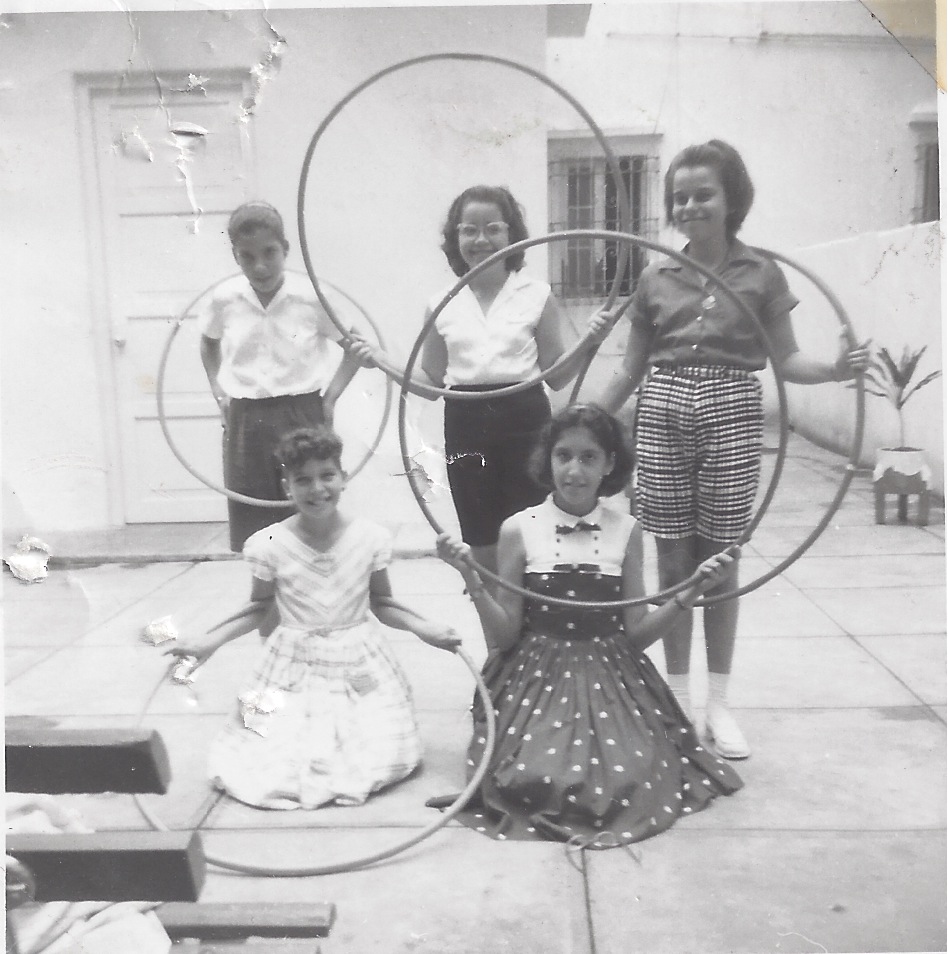
    With Piti, Ani, my cousin Eliana and Haydecita when Peter Pan was only a children’s story.


    March 30, 2013 marked the fifty- first anniversary of my arrival in the United States as a Pedro Pan child.  I was a part of the largest exodus of children in the history of the Americas, and still marvel at how few people in this country, ninety miles from the shores of Cuba, know of our history. Our real history, before the men dressed in olive green fatigues carefully and expeditiously re wrote it so that ten years after the Pedro Pans left the island, there was no record that we had ever existed.  We had not become part of our own history, or part of anyone else’s.  

    I was reunited with my family years later.  Since then I have buried my grandmother Celia, my great aunt Aurora, my precious godmother Celia, her beloved husband my Uncle Larry, my aunt Isel, my uncle Percy, my father Pablo and my mother Yolanda in this country.  My grandfather Pablo lies alone in the family mausoleum in Colón Cemetery in Havana, waiting in vain for all those who were once the center of his life to join him. The image of my grandfather alone in the mausoleum in Havana sometimes haunts my dreams.  As tourists without a clue of his suffering walk past admiring the architecture of his resting place, does he think one of us has finally arrived to keep him company?

    On days like today when the memory button is triggered, I remember the island where my bones were formed. It is an island that lives only in the memory of those of us who inhabited it before nineteen fifty nine, before the fighting, the blood, the bombs, the firing squads, and the terror, supplanted the repression of the Batista government; before the young men in olive green uniforms replaced a dictatorship with disaster. Before the parents of over one hundred thousand Cuban children decided to send them abroad alone having given up hope that they would ever taste the nectar of freedom in their own land.

    Only fourteen thousand six hundred children were able to leave before Fidel blocked every avenue of escape for us after the Cuban Missile Crisis.  The fourteen thousand six hundred children who despite having reached almost retirement age cannot entirely let go of our childhoods.

    You can see the reluctance to do so in our correspondence with each other on the Pedro Pan web site where past is present always, and where our endearments reflect the compassion of one child towards another, the understanding of the internal devastation suffered more than half a century ago.  We welcome one another like children: “welcome, hermanito, hermanita”! (little brother or sister), and the next question is never about what we do for a living, whom we married, or who our children are.  It is “where did you live in Cuba….  When did you get here….Were you in the camps….Where were you sent…Did your parents come?”

    Sometimes after over half a century a classmate’s name suddenly appears on the site, and as if time had never passed we come together with the force of great love and vivid remembrance of memories shared, and stick to one another like glue.  At that moment we realize our soul has been missing a piece in the shape of our friend, and we become friends again and forever in the land of Peter Pan.

    And like children, we have a price to pay for belonging to this exclusive clique.  We are required to lean to the political right if we’re going to be included among the “popular” kids. In a terrible reminder of the men dressed in olive green who oppressed our country,pehaps geneogramically unavoidably, the “in crowd” frowns on any freedom of choice that might include left leaning thought expressed out loud.  The fears of our childhood rise like inner monsters that blind us to the possibility that any answers to problems can be found left of center. We make an infinite line finite and small and narrow our vision.  Having fallen off the precipice so many years ago, we avoid the edges of any shadow that may hide the suggestion of an abyss.  Fool me once….

    Is it that rigidity that keeps us hidden from the world?

    The  right appears to embrace us while using us to promote their agenda.  The  left uses us as examples of traitors to a beloved cause.  What if we stood in the middle with our stories and let them speak loudly for themselves?  Wouldn’t they alone evoke in those who hear them a yearning for freedom?  Could we inspire a more inclusive world where tyranny would become unable to take its next breath?  Could our story make even the cynics of this world want to live on a planet where the laughter of children can be heard above the din of hatred and oppression and where the word exile would only be written in history books?  Would our story lose its power or grow exponentially along an infinite line?
    Image


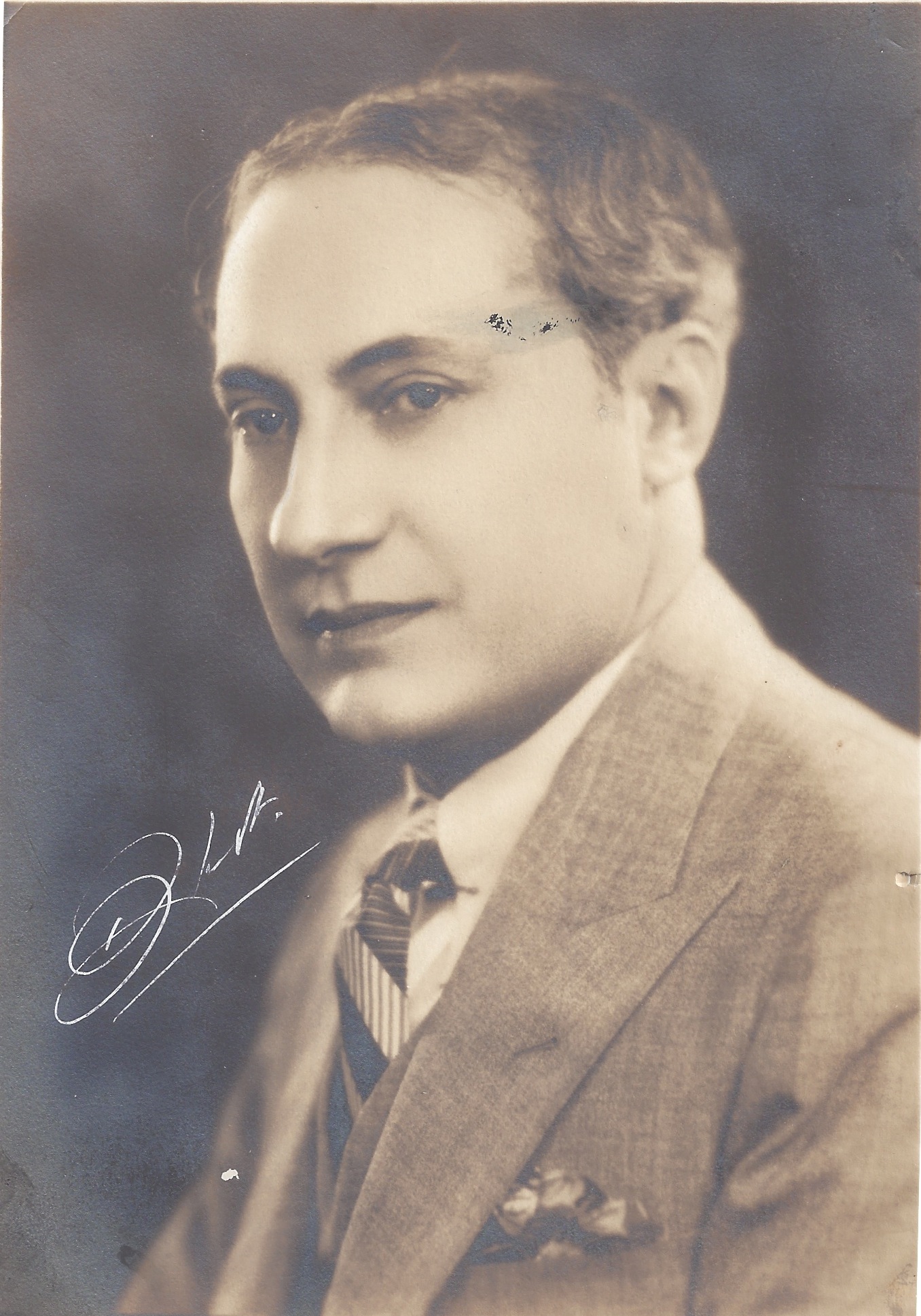
    My beloved grandfather Pablo Lopez Morales, a year before I was born.  I still miss you.

     

  • When my mother and father arrived in the U.S. they rented a small house in Miami, FL Coconut Grove area along with my cousins Marly and Eddy.  Eddy and I revisited the house a couple of years ago, almost fifty years later.  The house seemed even smaller to us, but it was painted and well taken care of.  The neighborhood appeared much better kept than we remembered.  The trees were taller, the streets and sidewalks pristine, it had become a quiet and charming place that I loved revisiting with him.

    Many of us have never revisited the homes we left behind in Cuba.  At first because we couldn’t, then because many of us wouldn’t, remembering the years of terror that we experienced during the Revolution.  Now our children are adults and many want to see what became of the land they only know from old pictures and from our stories, and as we face the evening of our lives we agree to take them back to where it all began.  Waiting for Fidel to die before “going home” is not an option any longer.  Time is of the essence.

    My friend Piti took her husband and her son to Cuba this month.  I confess I wanted to go with her to stand on the street where we grew up together, the street that watched us play and that one day witnessed our poignant good bye.  But it was not to be.  As much as I yearn to breathe  the the Cuban air again, I am still ambivalent about the journey.   The decision was made easier because  members of Piti’s extended family were traveling with her and there was no room for me.  It is not easy to find a van big enough for eight people in Fidel’s Cuba!

    Piti brought Cuba back with her in pictures.  As soon as she settled in she sent me over a thousand pictures taken by her son during their visit.  Unlike the experience I shared in Coconut Grove with my cousin, there was little of the familiar in the Cuba I got to visit glued to my computer screen in our Beaverton, Oregon condominium.  The men in the olive green uniforms look the same, but the land they took over, the land they purportedly came to save, is much the worse for wear.

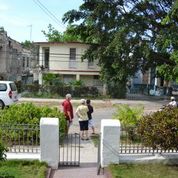
    This is my grandparent’s house.  The picture was taken shortly after I left, and sent to me in boarding school so I could feel close to home.

    Image

    Here is what Piti found….

    My house is a government building.  The cream colored house was built on our once beautiful yard and the structures behind the house are now invisible.  One of those was the Kindergarten my grandfather built for my aunt Isel where many neighborhood children left happy memories.

    Image

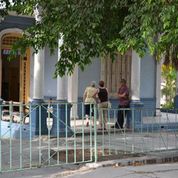
    This is Piti standing on the porch of the beautiful white house, now shabbily painted blue.

    Image

    And a front view.  Piti and her cousin were denied entry into the building.

    Image

    Piti’s own house next door and to the left cannot be seen in these pictures, but it is in much worse condition.  A man lives there now, one of the poor Fidel came to save, the house falling apart around him.  Fidel’s house?

    Image

    Now called Ground Zero you can see it in the background.  He also has a helicopter pad and another mansion on the same property near our old Country Club, the Habana Biltmore.  Someone sent me the picture which they had not taken themselves, so don’t know who to credit.  But you get the idea…..

    You say you want a Revolution?

  • My life is enriched by my gifted and creative friends.  Friends who year after year work to refine their craft, whether their craft is writing, photography, painting, or graphic design.  Many times recognition is slow to come by.  So I have decided to occasionally share with you some of my friends’ stories and projects in the hope that you will then share them with your relatives and friends.

    Today I dedicate this blog to my friend P.H. Wells.

    Pam is the creator of a venture called First Straw Films.  I met Pam almost a decade ago when I was introduced to the Writers in the Rafters, a group of remarkable women I am fortunate to share my creative journey with.  Pam and I are both writers, but while I write in the non fiction literary genre, she is a script writer.   Pam is not only successful in her own right, but she is a true mentor to her friends.  She is generous with her time and honest with her critique.  She is witty and daring, intelligent and compassionate.  I hope you enjoy seeing a little of her creation.

    Not so long ago Pam got a new camera and a new passion was born.  In what seemed an impossibly short time, she learned a new craft and started her own film company. I am proud to share her first film project with you today.

    The Associate Producer on Pam’s film, Joan MacBeth, is also my good friend and a member of the Writers in the Rafters.  She is an award winning script writer and a ray of sunshine in my life.  Her husband Ron, Cinematographer for the film, is a very good man who like Pam and Joan, values his friends.  I am very excited to share this project with all of you, as excited as if the project was my own.  These are people I love.

    Enjoy and if you can make a donation to help Pam reach her goal, please do!  Otherwise I hope you are the richer for having caught a glimpse of things to come…..

    ABOUT MY SHANGHAI

    On Memorial Day, 2011, Virginia McCutcheon was featured on the front page of the San Luis Obispo Tribune. The headline read: “POW of the Japanese.” She became an instant local celebrity as one of the last survivors of Lunghwa Camp in China during World War II.

    Virginia McCutcheon • © 2013 First Straw Films
    Virginia McCutcheon • © 2013 First Straw Films

    The camp experience is at the heart of the documentary, but Shanghai, “the Paris of the Orient,” is where it all began. In interviews over several days in the past year, Virginia, now age 93, opens up about herself, her family, her loves and losses, more than she ever thought she could.

    myshanghaifilm.com/

    I      

  • My daughter Karen posted the following message on Facebook today:

    “I shouldn’t have to have the conversations with my kids that I’ve had this week.  I shouldn’t have to learn that they have “burglar” drills at school, where doors are locked, lights are out, blinds are pulled and children hide in silence in the dark, under their desks.”

    Several of my friends have asked why I didn’t blog about Sandy Hook yesterday.  I couldn’t.  The incident rendered me wordless and all I wanted to do was to quietly and fervently pray for the children, the families, and our country.  Today I want to speak of the unspeakable.

    Last night little children who could have been tucked safely into their beds at home dreaming of Christmas, lay dead inside their school in the company of forensic experts.  Parents, who dreamt of making their children’s dream come true on Christmas morning, went home with aching empty arms and anguished souls.

    A woman was seen running from the scene of the shooting and screaming “Why, why?!”  And the pundits try to answer her unanswerable question for hours on end as we sit glued to a screen hanging on their every word, devouring tragedy.  As if the mere knowledge of the heinous act was not enough to fill us to capacity with grief, we want the details, please.

    This time, I opted out.  No news channel for me.  I found my consolation envisioning little souls crossing over into love with the adults that died with them, and angels holding the hearts of those left behind.  I thanked God for the blessings the little ones bestowed on their families in life, and for the goodness of a community that will rise to support its people.   I thanked God for a president that can be moved to tears by the fate of little children, because I never want us to be in the hands of a man or woman that cannot feel enough to cry.  And most of all, I thanked God that this time, my children and grandchildren were spared a direct confrontation with violence.

    I am tempted to talk about the why, or perhaps more appropriately the why nots, given the climate of anger that surrounds us, and our abandonment of the mentally ill. Not tonight.  Tonight I want to just reach out and gently touch you.  To remind you that darkness and hatred cannot rule the world as long as there is a spark of love.  And I want to offer a prayer not only for the children, but also for the adults- the principal, the teachers, who dedicated their lives to children and died with them.  May God bless them all.  And you. 

    My friend Cantrell has a signature at the end of each email.  It reads: “breathing peace”.  Cantrell, I have being doing that today and it has been a great consolation.  Thank you!

  • I am one of those fortunate writers who belongs to a writer’s group.  Every two weeks I meet with a cast of remarkable brilliant women who share my passion for words.  When I joined the group, it had been in existence for a few years and a couple of the original members had moved too far away to continue to attend.  Still, I heard their names often, and they remained present in their absence.  Sharon Mehdi was one of those women,  and she had just published a book.  I was thrilled when I heard she was going to visit us at our next meeting.

    This is what I knew about Sharon then: she was bright, funny, talented, and a good friend.   Her new book,  The Great Silent Grandmother Gathering: A Story For Anyone Who Thinks She Can’t Save The World, was selling quite well.   She had written the book for her unborn granddaughter. 

    The story begins like this:

    On a buffety, blustery early summer day, when the news was bad and the sky turned yellow, a strange thing happened in the town where I live.  


    I love an irresistible beginning.   She is a storyteller extraordinaire.  Her book was published in several countries and is well loved.

    Our writing group meets in the “upper room” of a coffee house in a small town in Oregon every second and fourth Saturday come rain, snow, extreme cold, severe heat wave, come anything!  And it was in the “upper room” that I first met Sharon when she came to visit us one day.  She graced us with her open smile and dancing eyes, prepared to share with us some magical new writing.  I felt an immediate connection with her and so enjoyed her reading in our group that day, that despite the years that passed I can almost quote those passages by heart. 

    I have gotten to know Sharon since then.  She led a group  to a gathering in Chartres Cathedral in France this fall.  I joined them.  The experience changed my life.  Recently, she surprised us with the news that her new book was to be published.  It is the book that contains the passages I never forgot! 

    So today I decided to postpone Part II of I Saw Grief- I will post it later this week- to bring you the news of this book I know you will love.  Her book is called A Curious Quest for Absolute Truth. Here is just a taste from her INTRODUCTION:

    “I don’t know exactly how old I was the first time I set off to see the world.  ‘Two years, ten months and still in diapers,’ my mother said every time she told the story.  All I know for sure is that one summer nap time I crawled out of my crib, put my favorite doll and a box of Morton’s Iodized Salt in a pink cardboard suitcase and toddled off down Olive Street.”

    Sharon will have some advance copies available on or about December 18th.  If you order right away there is a CHANCE you may get it in time for Christmas.  The price is $15.00 plus the cost of shipping from Ashland, Oregon to your address.  If you are interested in a copy email me and I will tell you what you need to do.  The book will be available on Amazon.com at the end of January.  Don’t miss it!

    To the women with whom I share the “upper room”, thank you for all you do and all you are!


  • I saw grief drinking a cup of sorrow and called out, “It tastes good, does it not?’

    “You’ve caught me, grief answered, “and you’ve ruined my business, how can I sell sorrow when you know it’s a blessing.”  Rumi

    I caught a glimpse of my godmother through the glass of the Pecera- the fish tank, at Havana airport.  Thick glass separated the passengers from their families.  Mina did not show emotion easily, and on that day in particular, it was important to her that I did not see her cry.

    The line of children waiting for the Militia men to go through our suitcases looking for contraband was long and I drifted towards where Mina stood helplessly.  I placed my hand on one side of the warm glass and she covered it with hers from the other side.  We had done this many times since I was little, skin to skin, as my hand struggled to grow as big as hers. Sweet innocent moments we both treasured…would there be more? Ever?  My throat was parched with thirst, but it was the rise of grief that almost closed it to my breath.  We looked in each other’s eyes soaking in our good bye in disbelief.

    My father was in Isla de Pinos prison.  His war of words with the Castro government, his stubborn belief that one man could make a difference, had won him a thirty year prison sentence in a prison whose walls were now full of explosives ready to detonate at the first signs of another invasion like the Bay of Pigs.  My mother, who had taken to her bed to nurse a nervous breakdown, was still there as I took my last steps on Cuban soil.

    Mina’s gaze left my face, as she took in the scene before her.  The Pecera was full of children.  Boys and girls, small children, adolescents, most of them alone but for a few lucky enough to travel with a brother or a sister, walked to a table.  One by one they watched as  each suitcase was emptied, and each piece of clothing was closely examined. Sometimes the men tore the lining of a suitcase thinking they felt something suspicious.  They had to be sure the children were hiding nothing.  There were no toys in the suitcases, not one familiar teddy bear or doll for a child to hold tight.  Fidel wanted to make sure we all left our childhoods behind.

    Mina looked at me again, our hands still touching, and mouthed “i’m going now.”  She pointed me towards the line of children.  I blew her a kiss, turned away from her, and obeyed.

    This scene, with myriad variations, was repeated over and over again, as more than fourteen thousand children with living parents became orphans in Miami and other places.  To this day, those of us who experienced the Pecera are bound to each other by our time in the fish tank- our second womb.

    For the last two years as the 50th anniversary of Operation Pedro Pan drew near, there were  small and large reunions that brought to the fore not only the memories of friendships established in camps and schools, but the palpable presence of our individual and collective grief; a grief that was not healed by a freedom so dearly paid for. Because it is the grief that sets us apart.  It is the grief, the sweet grief/love that we feel when we embrace each other, that adds a dimension to our friendships and strongly connects us fifty years later when we encounter old friends with whom otherwise we have little in common.  The threads that still knit us together are woven from children’s tears and choking grief.

    The last two years have been a time of healing, of contemplation and of soul searching for me personally.  You may have noticed the months of silence on my blog as I gave myself private time for my own journey.

    Looking back at the Pecera and at my Pedro Pan experience, I no longer feel the grief.  I see myself in that small glass enclosed space that embodied friends, enemies, war, anger, fear, and of course, grief; the world mirrored in a fish tank, and I am filled with gratitude.  I survived it all.  I am here living in the present.  I am whole, embracing peace, love, forgiveness, and leaving fear behind: truly free.  It feels amazing!

  • It’s all Fidel Castro’s fault.

    It was Fidel’s fault that our parents, brothers, sisters, and grandparents were shot or imprisoned.  It was Fidel’s fault that hundreds of our schools were closed in Cuba when our teachers were forced to leave the country because of their religious beliefs.  Slowly, relentlessly, the beliefs that nurtured for centuries, the beliefs that we cherished, were repudiated and then forbidden. Churches closed, and even God had to leave the island.

    Because of Fidel, we, the more than fourteen thousand children of the Pedro Pan airlift, embarked on a journey bereft of the arms that held us since our birth, leaving behind the embraces of our fathers and the tender caresses of our mothers, arriving in a strange land in search of something elusive that our parents could not stop speaking of:  freedom.

    Have we found it?

    As the Pedro Pan camps in Miami became crowded with more and more children arriving daily in that exodus born from the womb of our parents fear, we were sent to group homes, schools, and even orphanages, in over one hundred cities and thirty five States.

    When our journey to this thing called freedom took us away from our barely sprouting new roots, home became more distant and freedom and pain began to feel synonymous.

    Fully immersed in a new culture and language, the distance from home and our families appeared to be insurmountable. Still, even for those of us who feared no one would find us, who feared we would never find our way back, the hope was alive that we would see home again.

    “Don’t worry”, our parents had told us, “there is no way that the United States will tolerate a Communist government so close to its shore!  You will be coming home soon!”

    Soon would prove very elusive.  Soon would never come.  Soon would never come because of one man: Fidel Castro.  We, the children, never forgot his name.  Nor did our parents.

    For a half a century, while physical freedom has been possible, we are still in a yoke of our own making.  It is almost impossible for Cubans to get together without bringing up the subject of Fidel; almost impossible not to wake up and wonder if he is dead yet.  No matter how many thousands of miles we travel, Fidel is always in the suitcase.

    We will be in someone’s back yard celebrating the First Communion of a grandchild, talking about Fidel.  We will go home for a visit, and we will find him there, alive in our conversations.  We will be at a party celebrating the Fourth of July, celebrating our freedom, and he will be in our midst.  We crossed an ocean to escape him, only to find out we brought him with us.

    And that is our fault. And we are the only ones who can change it.

    Freedom will require of us the hardest thing of all.  It will require us to forgive the man and the harm he did to every one of us, the pain that he and those who followed him caused us.  Then we will achieve our parents’ dream for us, and walk through what is left of our lives weightless, with no one holding us down.

    I suspect the God that followed us to exile will be pleased….

    With permission of the artist, my friend Henry Flores-Galbis, I am sharing what seems to be a drawing lesson, but is much more.  In Henry’s own words:

    “This video accompanied the painting below at my show in Boston. It’s called But the Coat Remains. If there was a message through out the work it was that we have to  learn to get past the icons and the personalities and look at the situation on the ground.
     I think Bob Dylan closed his eyes and hit that nail on the head, “Don’t follow leaders—watch your parking meter.”
    Deconstructing Fidel http://youtu.be/BAQpVimVl9Y
  • Sunday morning greeted a beautiful land today.  

    The people who live in this beautiful land greeted the morning with fear, anger, and rocket fire, as their children woke to find their world falling apart.  

    Today it is the children of Israel and Gaza who suffer because their parents and grandparents have not learned to live in peace.  War is the way of their world, and they are learning its price at a time when they should be learning about the beauty of a rose, the feel of the grass under their feet, and the magic of play.

    The children will pay a high price for this madness.  Some will die, some will be orphaned, some will lose their homes, and others will forget how to be children once their hearts and minds are touched by the sheer ugliness of it all.  Innocence lost never to be found again.

    Tonight in our country we should take notice of where greed, hatred, and intolerance can take us as we lie snug in our beds in the land of freedom.

    But tomorrow we will wake up to a land that has forgotten how to treasure that freedom.  We will wake up to a country with a legislative body more interested in making sure our president doesn’t get anything he wants, than passing laws that will protect the rights and interests of its citizens.  We will wake up to the rumblings of citizens whose anger over their party losing an election has defeated their reason.  

    As we build up armies and navies and bombs and missiles to protect us from unseen enemies, who will protect us from ourselves?  Who will protect our children from ourselves?

    I dream of nobility and the love of freedom coming back into the hearts of our people.  Of tolerance replacing intolerance, of open mindedness replacing prejudice, and of love replacing hatred.  For if there is no self correction, no change of course, our freedom is in peril and the soldiers of many generations will have died in vain.

    Today it is Israel and Gaza.  Let us pray that tomorrow it is not us.  Let us make sure that tomorrow it is not us.  So the children don’t suffer.


    I remember vividly what it is like to wake up to a bed full of shattered glass from a bomb blast when I was a child.  


  • It was September 10th, a month ago, and my husband and I were at Charles De Gaulle airport in Paris.  The day before 9/11- a date that will never come again without bringing back memories of towers turning to dust as the hatred of our enemies exploded around us.

    We had just arrived in Paris on a flight from Iceland, where we spent a few days surrounded by the island’s pristine beauty.  Despite the always challenging experience of navigating a new airport, shedding and recovering possessions in the security line, and trying to make ourselves comfortable in a crowded airplane, we were  still feeling  the remnants of the serenity we experienced while bathing in the healing waters of Iceland’s Blue Lagoon.

    It was almost lunchtime, and we decided to find a restaurant.  After forcing our bodies back into rush mode to keep up with the crowds, we passed the familiar McDonald’s looking for a Parisian restaurant where we could set our suitcases down and create a little oasis for ourselves.  I was excited to try out my very rusty (70″s) French.  We found just the place and sat down to peruse a menu.  After we ordered our food and I realized that although I could still read and understand French speaking it was a whole other story,  we sat back and did what tourists do:  people watch.  We were treated to a parade of ethnic diversity!  A group of tourists from Nigeria (I had to ask!) dressed in gorgeous colorful indigenous garb, Latin Americans speaking in various accents of Spanish, Brazilians, Scandinavians, Russians, Indian women in their beautiful Saris, and what I assumed were Moslems from the way they were dressed. .  Our own Portland, Oregon, is a wonderfully diverse city where one can walk downtown and hear different languages spoken.  But the airport in Paris offered a representation of our world populations like none I had ever seen before.

    Suddenly our reverie was interrupted by several armed policemen and a couple of very focused German Shepherds.  The policemen began to rope off an area in front of the restaurant.  They came towards us and another group in the adjoining table and asked us to leave and go to the second floor.  Now.  Do not eat, do not pass go.  I recognized the cold sweat of terror, so familiar to me from my childhood.  We grabbed our bags and joined the rest of the colorful people on their journey to what we assumed was the safety of the second floor.  We still had hours before we could get on another airplane and head for Spain.  I asked a policeman in my tentative French what was happening (typical control freak behavior) and was told “a tourist has misplaced his luggage”.  Right.  And a whole floor of Charles de Gaulle airport was being vacated.  Guns.  Dogs.  Lost luggage….really?  But we obeyed, acutely aware of the date- the day before 9/11.  We had failed to realize the date was not only significant to us, but to the world.  The airport had been in a high state of alert and now they appeared to have had a reason.

    We never knew what happened.  As far as I know the incident never even made the news there or here.  But we stayed on the second floor until it was time to go to the gate for our next flight.  We sat down by the gate to wait, still hungry, tired, memories of the Blue Lagoon fading fast.  And then it happened.  What I assumed to be a whole group of Moslems sat next to us.  The familiar veiled women, the men suddenly appearing menacing in that context.  On the day before 9/11 we were going to get on a plane along with a group of Moslems.  I glanced at my husband and raised an eyebrow.  He responded with a nonchalant look.  I elbowed him and tried to point my finger in the direction of my neighbors without their noticing it.  He still wasn’t reacting.  Why?

    I got up, impatient, and walked to a nearby Starbucks, suddenly wanting a familiar space.  I was charged over five euros for an ice coffee.  So now I was hungry, tired, afraid of my new neighbors and feeling cheated, having spent double the money for my favorite drink.  As I returned to my seat I looked at the “muslims” who had taken the seats next to us.  A man, two older women, a child and a teenager.  A beautiful teenager sat in the seat next to me.  A family.  I wish I could say that my fears were allayed, but they weren’t.  My PTSD had kicked in.  You could call it paranoia.  Moslems thought nothing of blowing themselves up- why not their children?  Suddenly I wished the security people had been even more paranoid than I.  It was then that the little boy got up and said something that made his sister the teenager laugh.  And what a beautiful laugh she had!  The laughter brought me back to myself.  To the self that swore that she wasn’t prejudiced.  To the self who said many times that we could not blame a whole population for what a few people did.  And I breathed deep and turned to the beautiful teenager with the large black almond intelligent eyes, her head partially covered, and I said:  “Hello, do you speak English, Spanish or French’?  And she answered me in perfect English that yes, she spoke English.  Her name was Nahil.

    Nahil and her family were Syrian.  Nahil was fourteen, the same age I was when I was sent to the U.S. from Cuba leaving everything familiar behind.  She spoke of her grandma and her cousins she could no longer visit.  At least not as long as her country was under siege.  She spoke to me of Syria with the longing and love I myself had felt at her age at another airport far away.  Nahil couldn’t go home at fourteen.  Nahil and I were sisters.  I sat down next to my sister and I did not recognize her.  I didn’t even SEE her- only her dress!  And yet…..

    Fifty years later, Nahil is another child whose life has been turned inside out by violence and war.  Fifty years and we have learned nothing.  Fifty years and the children continue to be the victims of the inability of adults to dialog and come to consensus over difficult issues.  Fifty years and children cannot rest easy in their homes, can’t count on growing old in the country of their birth.  I had been Nahil, and my fear had almost kept me from knowing her.

    Is it our fear that drives all wars?  The fear that almost kept me from knowing Nahil’s beautiful spirit?

    Nahil is strong.  She lives with her family in another land now and they live comfortably.  She will survive as I did.  But like me, she will long for her friends, her cousins, and wonder what might have been, because some adults forgot how to be stewards of their country and their children, while caught in the ego led power struggles that bring forth nothing but destruction.

    So Nahil, forgive me for my prejudices, I wish with all my heart that someday you will again walk in your land in freedom.  Someday soon.  Before your beautiful strength and your hope fade.  Before your country is destroyed by its own people.

    When it came time to board our plane, Nahil and her family boarded the plane next to us also boarding at the same time.   NOT headed for Spain.  I felt a pang of regret.  I would have loved to have known her better.

    How many people do we miss meeting, knowing, loving, because of our deep seated prejudices and fears?

    I suspect we are missing out on a big part of our human experience………..

    .